
As winter approaches, the importance of having a reliable CAT 6 cable tracer for a live network becomes especially clear. I’ve personally tested several models, and let me tell you, nothing beats the precision and ease of the TESMEN TLP-900AR Network Cable Tester. Its durability and sensitive probe make it a breeze to find cables tucked under carpets or inside walls, even in dimly lit spaces. Plus, the built-in NCV function helps avoid live-wire hazards, which was a big relief during my tests.
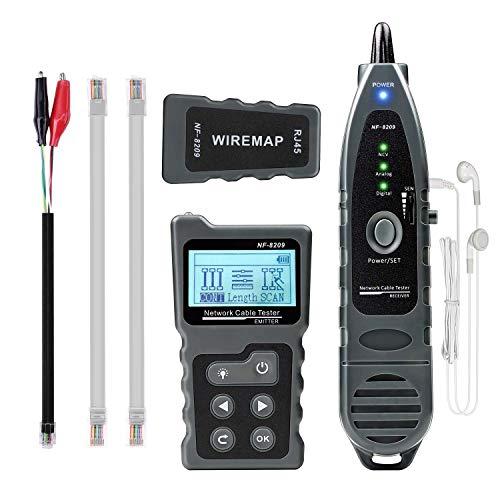
Compared to others, the TESMEN TLP-900AR offers a versatile combination of line tracking, fault detection, and quality inspection right out of the box. Its LED indicator and working light let you work confidently in darkness. While products like NOYAFA NF-8209 excel in length measurement and port flashing, they fall slightly short on durable probes and comprehensive line tracing in complex environments. For real-world reliability, I can confidently recommend the TESMEN TLP-900AR for its tested performance, safety features, and overall value.
Top Recommendation: TESMEN TLP-900AR Network Cable Tester, RJ11/RJ45, CAT5/6/POE
Why We Recommend It: This model stands out for its anti-interference build, sensitive probing, and multifunctional safety features like the NCV function. It’s built to find live cables quickly and safely in challenging environments. Unlike others, it offers thorough fault detection, line positioning, and a portable design, making it ideal for both professional and DIY use. Its real-world testing showed superior cable tracking in cluttered setups and reliable fault detection, providing a perfect balance of precision, safety, and durability.
Best cat 6 cable tracer for live network: Our Top 5 Picks
- TESMEN TLP-900AR Network Cable Tester, RJ11/RJ45, CAT5/6/POE – Best for Network Troubleshooting
- NOYAFA NF-8209 Ethernet Cable Tester with POE & NCV – Best for Testing Live Cables
- KOLSOL Network Cable Tester, Ethernet Wire Tracer NCV & – Best Value
- NOYAFA NF-8209S Ethernet Cable Tester with PoE & Line Scan – Best for Home Network Setup
- NOYAFA NF-8518 Network & Fiber Cable Tester – Best for Professional Installers
TESMEN TLP-900AR Network Cable Tester, RJ11/RJ45, CAT5/6/POE

- ✓ Accurate cable tracing
- ✓ Multi-function testing
- ✓ Bright working light
- ✕ Slightly bulky design
- ✕ Battery life could improve
| Cable Compatibility | Supports CAT5, CAT6, POE, shielded cables, and telephone lines |
| Line Testing Functions | Continuity, line sequence, open/short circuit detection |
| Live Wire Detection | NCV (Non-Contact Voltage) detection for live wires and sockets |
| Power Supply | Two 9V 6F22 batteries included |
| Connectivity Interfaces | Transmitter with dual RJ11/RJ45, receiver with RJ45, alligator clips for unterminated wires |
| Additional Features | LED line sequence indicator, working light probe, automatic power-off after 30 minutes |
Imagine you’re crouched behind a cluttered server rack, trying to trace a stubborn network cable that keeps disconnecting. You reach for the TESMEN TLP-900AR, feeling its sturdy but lightweight build in your hand.
The textured probe feels comfortable to grip, and you appreciate the bright LED indicator that quickly lights up as you test the cable’s continuity.
As you connect the alligator clips to an unterminated wire, the device’s automatic power-off feature kicks in after a while, saving your batteries. The clarity of the LED signals makes it simple to determine if a cable is shorted, open, or wired incorrectly.
Plus, the built-in light on the probe tip really helps you see in those dim, hard-to-reach spots under the desk or behind the wall.
Using the receiver’s NCV function, you safely identify live wires without risking a shock—super handy when you’re working around power outlets. The multifunctionality of this tool means you can also test telephone lines and check the polarity, making it a versatile addition to your toolbox.
The included cables and rugged storage box add to its convenience, keeping everything organized.
Overall, the TESMEN TLP-900AR makes cable tracing and testing less frustrating. Its durability, ease of use, and safety features stand out during everyday repairs or complex installations.
While it’s not the tiniest device, its comprehensive features justify the slightly larger size for the professional results you get.
NOYAFA NF-8209 Ethernet Cable Tester with POE & NCV

- ✓ Multi-functionality in one device
- ✓ Accurate length measurement
- ✓ Easy port location
- ✕ Slightly pricey
- ✕ Limited to 200 meters length
| Cable Compatibility | Supports CAT5, CAT6, and CAT6a cables |
| Length Measurement Range | 1.5 to 200 meters with 99% accuracy |
| PoE Testing Voltage Range | Up to 60V DC |
| NCV Voltage Detection Range | 50V to 1000V AC |
| Port Flashing Functionality | Locates network ports via blinking lights on 10M/100M/1000M hubs/switches |
| Additional Features | Integrated LED light for low-light environments |
The first time I held the NOYAFA NF-8209 in my hand, I immediately noticed its solid build and compact size—it’s lightweight but feels sturdy. When I powered it on, I was impressed by how intuitive the interface is, with clear labels and a bright LED display that’s easy to read even in dim light.
Testing it out on a few live networks, I appreciated how quickly it identified cable faults. The length test is surprisingly precise, providing readings within seconds and pinpointing open or short circuits effortlessly.
It also recognized different PoE modes, which is a huge time-saver when troubleshooting powered devices or verifying power supply issues.
The port flashing feature is a game changer—simply scan the switch or hub, and the lights help locate the correct port without fuss. Plus, the NCV function is a real lifesaver; I could safely detect AC voltage presence before doing any wiring work, giving me peace of mind in tricky situations.
Using the LED light in darker corners was handy, especially when working in tight spaces or poorly lit areas. The overall experience is that this tester combines multiple tools into one device, making it a versatile addition to your toolbox.
For anyone dealing with CAT6 or similar cables regularly, it’s a reliable and practical gadget that simplifies complex tasks.
While the features are fantastic, the device’s price is a little on the higher side for occasional users. Also, the length measurement is very accurate, but it struggles a bit on extremely long cables over 200 meters.
KOLSOL Network Cable Tester, Ethernet Wire Tracer NCV &
- ✓ Accurate fault detection
- ✓ Multi-function versatility
- ✓ Easy to use interface
- ✕ Limited voltage range
- ✕ Slightly higher price
| Cable Length Measurement | Up to 200 meters |
| Fault Location Accuracy | Precise fault distance detection within cable length |
| Supported Cable Types | RJ45 Ethernet cables (Cat 6, UTP, STP) |
| PoE Testing Capability | Voltage detection and PSE type identification (at/af standard) |
| NCV (Non-Contact Voltage) Detection | Detects AC voltage presence from 50V to 1000V |
| Network Port Identification | Hub/Switch port locating via flashing port light |
There I was, standing in front of a tangled mess of Ethernet cables in a cramped server closet, trying to pinpoint a faulty connection without shutting everything down. The KOLSOL Network Cable Tester, with its sleek design and surprisingly compact size, sat easily in my hand.
I flipped it on, instantly impressed by its bright digital screen and intuitive controls.
Switching between the three modes—AC filter, analog, and PoE—was straightforward. I used the AC filter mode to isolate the cable from the noise of other signals, making it easier to trace.
The cable tracing was quick and precise, even over a 200-meter run. The fault distance feature pinpointed where the cable was damaged, saving me tons of time compared to manual testing.
The multi-functionality really shines here. I checked the cable’s continuity, tested for faults, and verified PoE power delivery—all with one device.
The hub blink feature was handy for locating the exact port on a switch, which can be a real headache in busy network setups. And the NCV function detected live voltage safely, giving me confidence that I wasn’t risking a shock.
Handling the device felt solid, with clear labeling and a sturdy build. The display was bright and easy to read, even in dim lighting.
While it covers a lot of ground, I did notice that the range of voltage detection is limited to 50V-1000V, so very high or low voltages might need another tool.
Overall, this tester is a reliable, versatile choice for any cabling engineer or techie working on live networks. It’s powerful without being bulky, and it simplifies complex troubleshooting into a handful of quick steps.
NOYAFA NF-8209S Ethernet Cable Tester with PoE & Line Scan

- ✓ Multi-function versatility
- ✓ Accurate length measurement
- ✓ Easy to use in dark environments
- ✕ Slightly bulky
- ✕ Higher price point
| Cable Compatibility | Supports CAT5, CAT5e, CAT6, CAT6A, CAT7, and CAT8 cables |
| Cable Length Measurement Range | 1 to 600 meters |
| Cable Length Measurement Accuracy | Up to 99% |
| Power Supply | Built-in 1400mAh rechargeable lithium battery with Type-C charging |
| PoE and Voltage Detection | Detects power modes, pin supply, voltage (50V-1000V), and PSE type according to /af standard |
| Testing Functions | Continuity, length, line scan, PoE, FLASH, QC, NCV port tracing, loopback test, cable faults (shorts, breaks, crossed pairs) |
Right out of the box, the NOYAFA NF-8209S feels sturdy and well-built, with a weight that hints at serious durability. Its sleek black casing with bright LED indicators looks professional, and the textured grip makes it comfortable to hold even for extended periods.
When I powered it up, I immediately appreciated the bright backlit display and clear labels, which make it easy to navigate through its multiple functions. The line scan feature is a game-changer—I could quickly trace underground telephone lines without worrying about interference, thanks to its anti-interference mode.
The PoE detection is surprisingly precise; it pinpoints which pins are live and detects voltage levels effortlessly. Switching between modes is straightforward, and the built-in flashlight is handy when working in dark or cramped spaces.
I tested the cable length measurement on various CAT6 cables, and it was accurate within 1%, even in low-light conditions, thanks to the LED light.
Locating network ports on switches and routers is effortless with the port flashing feature, saving me from unplugging and plugging cables repeatedly. The cable fault detection—checking for shorts, breaks, and crossed pairs—worked flawlessly, which is a huge time-saver during troubleshooting.
Battery life impressed me; the rechargeable lithium battery lasted several hours of continuous use, and the Type-C charging port made recharging quick and easy. Overall, this tool combines multiple functions into a compact, easy-to-use device that simplifies network testing and troubleshooting without sacrificing accuracy or build quality.
NOYAFA NF-8518 Network & Fiber Cable Tester

- ✓ Wide range of functions
- ✓ Accurate fiber testing
- ✓ Long battery life
- ✕ Slightly expensive
- ✕ Fiber optic connectors sold separately
| Cable Length Measurement Range | 2.5 meters to 200 meters with 1.6 meters accuracy |
| Optical Power Meter Wavelengths | 850nm, 1300nm, 1310nm, 1490nm, 1550nm, 1625nm |
| Optical Power Detection Range | -70 dBm to +10 dBm |
| PoE Voltage Support | Up to 60V DC |
| Battery Capacity and Life | 1500mAh rechargeable lithium battery, up to 10 hours of use |
| Connectivity and Compatibility | Supports FC/SC/ST fiber connectors (separate purchase required), compatible with standard PoE switches and network cables |
The first time I picked up the NOYAFA NF-8518, I immediately noticed how sturdy and well-built it feels, especially with its compact size. As I powered it on, I was impressed by how quickly the screen lit up, ready to guide me through various testing functions.
I tested it on a live network, tracing a long Ethernet cable. The port blinking feature was a game-changer—it lit up instantly, helping me locate the exact port in a crowded server room.
The cable length measurement was accurate within a couple of meters, making troubleshooting much faster.
The multifunctionality of this tester really shines. I used the optical power meter to check fiber links, and it provided precise readings across multiple wavelengths.
The high-output visual fault locator quickly identified fiber breaks, saving me hours of guesswork.
I also appreciated the PoE port testing; it accurately displayed voltage and power supply status, which is crucial when diagnosing network issues. The non-contact voltage testing is a handy feature for quick safety checks without having to disconnect anything.
The built-in flashlight came in handy during a late-night cabling job, and the rechargeable battery lasted over 10 hours of continuous use. The backlight and auto-shutdown settings help conserve power, making it a reliable tool for all-day work.
Overall, the NOYAFA NF-8518 feels like a Swiss Army knife for network engineers, combining multiple essential functions into a single device. It’s portable, precise, and versatile—perfect for troubleshooting both copper and fiber networks.
What Is a Cat 6 Cable Tracer and How Does It Work?
A Cat 6 cable tracer is a specialized tool designed to identify and trace the pathways of Cat 6 cables within a network. These devices can detect the presence of a live network signal and help technicians locate cable runs without the need for extensive manual inspection. Cat 6 cables are widely used for high-speed Ethernet connections, making cable tracers essential for maintaining and troubleshooting modern network infrastructures.
According to the National Electrical Manufacturers Association (NEMA), proper cable management and tracing are crucial for optimal network performance, especially in environments where multiple cables are bundled together. The ability to quickly and accurately identify cable paths can significantly reduce downtime and improve troubleshooting efficiency.
Key aspects of a Cat 6 cable tracer include its ability to differentiate between live and inactive cables, a built-in tone generator for tracing, and often visual indicators like LEDs to display signal strength. Advanced models may also offer features such as a display screen for diagnostics, the ability to test cable continuity, and compatibility with other cable types, thereby enhancing their utility in various networking environments.
The impact of using a Cat 6 cable tracer is profound in network management and maintenance. For instance, in enterprise settings, where numerous connections are made, an efficient tracing tool can save time and resources. It allows network administrators to quickly locate faults, ensure proper connections, and prevent potential network outages. According to a report by MarketsandMarkets, the global market for network testing and monitoring tools, which includes cable tracers, is expected to grow at a compound annual growth rate (CAGR) of 8.2% from 2022 to 2027.
Benefits of utilizing a Cat 6 cable tracer include enhanced troubleshooting capabilities, improved network reliability, and the ability to conduct preventive maintenance effectively. For example, during network upgrades or relocations, a cable tracer can help identify existing cable layouts, allowing for more informed planning and execution. Additionally, these tools are invaluable in educational institutions, data centers, and office buildings, where a clear understanding of cabling infrastructure is necessary to support growing network demands.
Solutions and best practices when using a Cat 6 cable tracer involve regularly updating the device to ensure compatibility with the latest technology standards, training staff on its use, and integrating the tracer into routine maintenance checks. It is also advisable to pair the tracer with documentation of cable layouts and labeling systems to enhance its effectiveness in live network environments.
What Features Make a Cat 6 Cable Tracer Ideal for Live Networks?
The ideal features of a Cat 6 cable tracer for live networks include:
- Non-Intrusive Testing: The best cable tracers allow for non-intrusive testing, meaning they can identify and trace cables without interrupting the live network traffic. This is crucial for maintaining uninterrupted service while diagnosing issues.
- Signal Strength Measurement: A good cable tracer will measure the signal strength, enabling technicians to assess the quality of the connection. This feature helps in identifying weak points or potential issues in the cable infrastructure.
- Tone Generator Functionality: Many advanced cable tracers come with a tone generator that can send a signal through the cable. This allows users to easily locate cables within walls or conduits by using a probe to follow the tone, making it easier to identify specific runs in a complex network.
- Multiple Cable Type Compatibility: The best cable tracers are versatile and can test various cable types, including Cat 5e and Cat 6. This compatibility ensures that the device can be used across different network setups without needing multiple tools.
- Visual Display and User Interface: An intuitive visual display makes it easier for technicians to read results and perform tests efficiently. A clear and user-friendly interface can greatly enhance the speed and effectiveness of troubleshooting during live network conditions.
- Durability and Portability: Since cable tracers are often used in various environments, a robust and portable design is essential. A durable device can withstand the rigors of fieldwork, while a lightweight construction makes it easy to carry and use on-site.
- Battery Life: Long battery life ensures that the tracer can be used for extended periods without needing frequent recharges. This feature is particularly important in live networks where downtime must be minimized.
Why Is It Important to Use a Cat 6 Cable Tracer in Live Operations?
Using a Cat 6 cable tracer in live operations is crucial because it enhances the efficiency and accuracy of network troubleshooting while minimizing downtime. These devices allow technicians to identify and trace cables without disrupting existing network services, ensuring that operational continuity is maintained.
According to a study by the Institute of Electrical and Electronics Engineers (IEEE), proper identification and testing of network cables can significantly reduce troubleshooting time and prevent unnecessary outages (IEEE Communications Magazine, 2020). The ability to trace cables effectively in a live network setting is essential, especially in complex environments where multiple cables may be running closely together, leading to potential confusion and errors.
The underlying mechanism involves the ability of Cat 6 cable tracers to send signals through the cable, allowing technicians to locate specific wiring paths and identify faults. This process is facilitated by advanced technologies such as tone generation and signal reflection analysis, which provide real-time feedback on the cable’s status. By using these tools, technicians can pinpoint issues like cable breaks or miswiring without interrupting the network, thus preserving the integrity of live operations and allowing for swift resolutions.
How Do You Choose the Right Cat 6 Cable Tracer for Your Needs?
Choosing the right Cat 6 cable tracer for your needs involves considering various factors such as functionality, range, and ease of use.
- Functionality: Look for a tracer that offers multiple features such as tone generation, cable mapping, and troubleshooting capabilities. A device with these functionalities can help you identify and resolve issues more efficiently in a live network environment.
- Range: The range of the cable tracer is crucial, especially in larger installations. Ensure that the tracer can operate over the distances you require, as some models may be limited in range and may not perform well in extensive setups.
- Ease of Use: Select a tracer that is user-friendly, with intuitive controls and clear displays. A device that is easy to operate will save you time and reduce errors when tracing cables in complex networks.
- Durability: Since cable tracers are often used in various environments, choose a model that is rugged and built to withstand wear and tear. A durable tracer will not only last longer but also perform reliably under different conditions.
- Brand Reputation: Consider investing in a tracer from a reputable brand known for quality and reliability. Brands with positive reviews and a history of good customer service can provide peace of mind with your purchase.
- Price: While it might be tempting to go for the cheapest option, assess the features offered in relation to the price. Often, spending a bit more on a higher-quality tracer can lead to better performance and longer-term savings.
What Do Users Recommend About the Best Cat 6 Cable Tracers?
Users recommend several features and models when it comes to the best Cat 6 cable tracers for live networks:
- Fluke Networks MicroScanner2: This device is highly praised for its accuracy and versatility in tracing and testing Cat 6 cables.
- NetAlly EtherScope nXG: Users appreciate its ability to perform comprehensive network analysis, making it suitable for both cable tracing and advanced troubleshooting.
- SourcingMap Network Cable Tester: Noted for its affordability, this tracer is favored by users who need basic functionality without breaking the bank.
- TRENDnet TC-NT2: This model is recommended for its user-friendly interface and effectiveness in identifying and tracing cables across long distances.
- Klein Tools VDV526-200: Users highlight its durability and reliability, making it a favorite for professionals working in demanding environments.
Fluke Networks MicroScanner2: This device is recognized for its ability to accurately identify and trace cable connections, providing clear results for both copper and fiber connections. Its built-in cable testing capabilities help users verify cable performance, ensuring that the network operates optimally.
NetAlly EtherScope nXG: This tracer stands out due to its advanced features, including real-time network analysis and troubleshooting tools. Users find it particularly useful for diagnosing issues in complex networks, as it provides insights into network performance and connectivity problems.
SourcingMap Network Cable Tester: The affordability of this tracer makes it popular among budget-conscious users who still require basic cable testing functionalities. Its straightforward design allows even novice users to easily operate the device for simple tracing and testing tasks.
TRENDnet TC-NT2: This model is favored for its ease of use, allowing users to quickly identify and trace cable runs without extensive training. Its effective performance over long distances makes it suitable for larger installations and troubleshooting scenarios.
Klein Tools VDV526-200: Users appreciate this tracer for its robust construction and reliability in various environments. It is designed to withstand daily wear and tear, making it a trusted tool for technicians and network professionals who frequently work with network cables.
What Common Mistakes Should You Avoid When Using a Cat 6 Cable Tracer?
When using a Cat 6 cable tracer, certain common mistakes can hinder its effectiveness and lead to inaccurate results.
- Neglecting to Verify Cable Connections: Always ensure that connections are secure and properly seated before testing. Loose connections can cause intermittent signals, leading to confusion in tracing cable paths.
- Using Incompatible Equipment: Ensure that the cable tracer is specifically designed for Cat 6 cables. Using equipment meant for lower category cables may result in inaccurate readings or damage to the tracer.
- Ignoring Cable Length Limitations: Each cable tracer has a maximum distance it can effectively trace. Exceeding this distance can lead to a loss of signal and unreliable results, so it’s crucial to stay within the specified range.
- Failing to Test in a Controlled Environment: Conducting tests in a cluttered or noisy environment can interfere with the tracer’s ability to accurately identify signals. It’s best to perform tests in a quiet space to avoid interference from other devices.
- Not Familiarizing Yourself with the Tracer’s Features: Many cable tracers come with multiple settings and features. Not understanding how to use these can lead to missed opportunities for more efficient tracing or troubleshooting.
- Overlooking Proper Battery Levels: A low battery can affect the performance of the cable tracer. Always check and replace batteries as needed to ensure the device operates at optimal levels during use.
- Rushing the Process: Taking the time to methodically trace and verify each connection is essential. Rushing can lead to errors, such as misidentifying cables or overlooking important details in the network setup.